Varanasi Ghats - Mansarowar Ghat

Varanasi Ghats - Mansarowar Ghat :
Built by Raja Man Singh of Amber and named after the Tibetan lake at the foot of Mt. Kailash, Shiva's Himalayan home.
Mansarovar Ghat was built by Raja Man Singh of Amber and named after the Tibetan lake at the foot of Mt. Kailash, Shiva's Himalayan home, at the top of this ghat there is a sacred pond , in replicated form ,representing the famous sacred lake of the same name lying in Tibet.

Varanasi Ghats - Munshi Ghat

Varanasi Ghats - Munshi Ghat :
The Munshi Ghat is a short ghat located north of Dashaswamedh Ghat, between Ahilyabai Ghat and Darbhanga Ghat along the Ganges in Varanasi. Its proximity to Dashaswamedh Ghat means that the Munshi Ghat is choked full of boats. By the way, the word "munshi" means "accountant" in Hindi. Very picturesque and worth a photo if you can get one. The ghats are always full of life. Pilgrims wading in the Ganges; vendors selling flower garlands and other objects used in worship; priests giving blessings or chanting scriptures under large umbrellas—a variety of people can be found at the ghats, no matter what time of day. Everywhere, street life and religious ritual intersect.
The ghats grow even more crowded on festival days, when up to hundreds of thousands of people can flock into Varanasi from all over India. During Divali, the “festival of lights” in late October, worshippers float clay lamps along the river. During Holi, held in the spring, people splash each other with colored powder and water. There are also hundreds of minor festivals that are celebrated only by those from a certain region, or by those of a certain caste.

Varanasi Ghats - Mir Ghat

Varanasi Ghats - Mir Ghat :
Mir Ghat has a shrine to Vaishalakshi, the Wide-Eyed Goddess, which is one of the holy Shakti Peetha. Here is also an famous site Dharma Kupa, the Well of Dharma. A shrine to Vishalakshi (the wide-eyed goddess).
It is one of the 52 pithas (pilgrimages) where the body parts of Shakti landed after a distraught Shiva performed his dance of destruction or tandava.

Varanasi Ghats - Raj Ghat

Varanasi Ghats - Raj Ghat:
Raj Ghat was a famous ferry ghat during the 19th century. Later a bridge was built here by Lord Duffrin, and it was named Malaviya Bridge in 1948, after Madan Mohan Malaviya, the founder of Banaras Hindu University.
The Gahadavala inscriptions of the 10th century state the glory of the ghat. There are four water-teerthams associated with this ghat, such as Sankhya, Uddalaka, Hayagriva and Nilagriva.

Varanasi Ghats - Scindia Ghat

Varanasi Ghats - Scindia Ghat :
Bordering Manikarnika to the north is the picturesque Scindia Ghat, with its titled Shiva temple lying partially submerged in the river, having fallen in as a result of the sheer weight of the ghat's construction around 150 years ago.
Above the ghat, several of Kashi's most influential shrines are hidden within the tight maze of alleyways of the area known as Siddha Kshetra (the field of Fulfilment). Vireshvara, the Lord of all Heroes, is especially propitiated in prayer for a son; the Lord of Fire, Agni, was supposed to have been born here.

Varanasi Ghats - Adi Keshva Ghat

Varanasi Ghats - Adi Keshva Ghat :
Above Trilochana Ghat, further north, is the holy ancient lingam of the Three (tri) Eye (lochana) Shiva. Beyond it, the river bypasses some of Varanasi's oldest precincts, now predominantly Muslim in character; the ghats themselves gradually become less impressive and are usually of the kaccha (clay-banked) variety.
At Adi Keshava Ghat (the "Original Vishnu"), on the outskirts of the city, the Varana flows into the Ganga. Unapproachable during the rainy season, when it is completely submerged, it marks the place where Vishnu first landed as an emissary of Shiva, and stands on the original site of the city before it spread southwards; around Adi Keshva are a number of Ganesha shrine. On the outskirts of the city is the point where the river Varuna meets the Ganga. The ghat is completely submerged during the rainy season. This is the original site of the city, where Vishnu is believed to have landed as an emissary of lord Shiva.
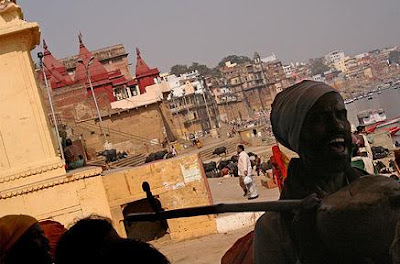
Varanasi Ghats - Panchganga Ghat

Varanasi Ghats - Panchganga Ghat :
Where five rivers are supposed to meet, dominating the ghat is Auangazeb's small mosque, also known as the Alamgir Mosque, which he built on the site of a large Vishnu temple erected by the Maratha chieftain Beni Madhav Rao Scindia. Beyond Lakshmanbala Ghat, with its commanding views of the river. Lies one of the most dramatic and controversial ghats, Panchganga Ghat, dominated by Varanasi's largest riverside building, the great mosque of Alamgir, known locally as Beni Madhav-ka-Darera. With its minarets now much shortened, the mosque stands on the ruins of what must have been one of the city's greatest temples, Bindu MadhavaBold, a huge Vishnu temple that extended from Panchganga to Rama Ghat before it was destroyed by Aurangzeb and replaced by an impressive mosque. Panchganga also bears testimony to more favourable Hindu-Muslim relations, being the site of the initiation of the medieval saint of the Sufi-Sant tradition, Kabir , the son of a humble Muslim weaver who is venerated by Hindus and Muslims alike.
Along the river front lies a curious array of three-sided cells, submerged during the rainy season, some with lingams, others with images of Vishnu, and some empty and used for meditation or yoga. One of these is a shrine to the Five (panch) Rivers (ganga), which, according to legend, have their confluence here: the two symbolic rivulets of Dhutapapa (Cleansed of Sin) and the Kirana (Sun's Ray), which join the mythical confluence of the Yamuna and the Yamuna and the Sarasvati with the Ganga.

Varanasi Ghats - Ram Ghat

Varanasi Ghats - Ram Ghat:
Located near the Harsiddhi Temple, is considered important. The Ram Ghat was built by the Raja of Jaipur.
Ramnavami MELA held at the Ram Ghat, on the 9th day of Chaitra in the early morning people of Hindu religion take bath together at the Ghat, and Worships Ram in the neighboring Temple.

Varanasi Ghats - Trilochan Ghat :

Varanasi Ghats - Trilochan Ghat :
Two turrets merging from the river between which, the water is said to be especially holy. The Trilochan Ghat has two turrets merging from the river, and water between them is especially holy.
This ghat is named after famous image of Shiva Trilochana (three-eyed), whose lingam is known as Trilochanesvara.The kashi khanda and other contemprary digests have composed many meteres in glory of this ghat and its associated water tirtha ,Pilatippala tirtha.

Varanasi Ghats - Dattatreya Ghat :

Varanasi Ghats - Dattatreya Ghat :
Bears the footprint of a Brahmin saint of the same name in a small temple nearby. Dattatreya Ghat bears the footprint of Brahmin saint of that name in a small temple nearby.
This Ghat is named after the scholar saint who was supposed to be the incarnation of the Holy Trinity. Beyond this is the Scindia Ghat built by Baija Bai the queen of Daulat Rao Scindia of Gwalior. The structure was so huge and magnificent that it collapsed into the river and had to be rebuilt.

LinkWithin

Related Posts with Thumbnails